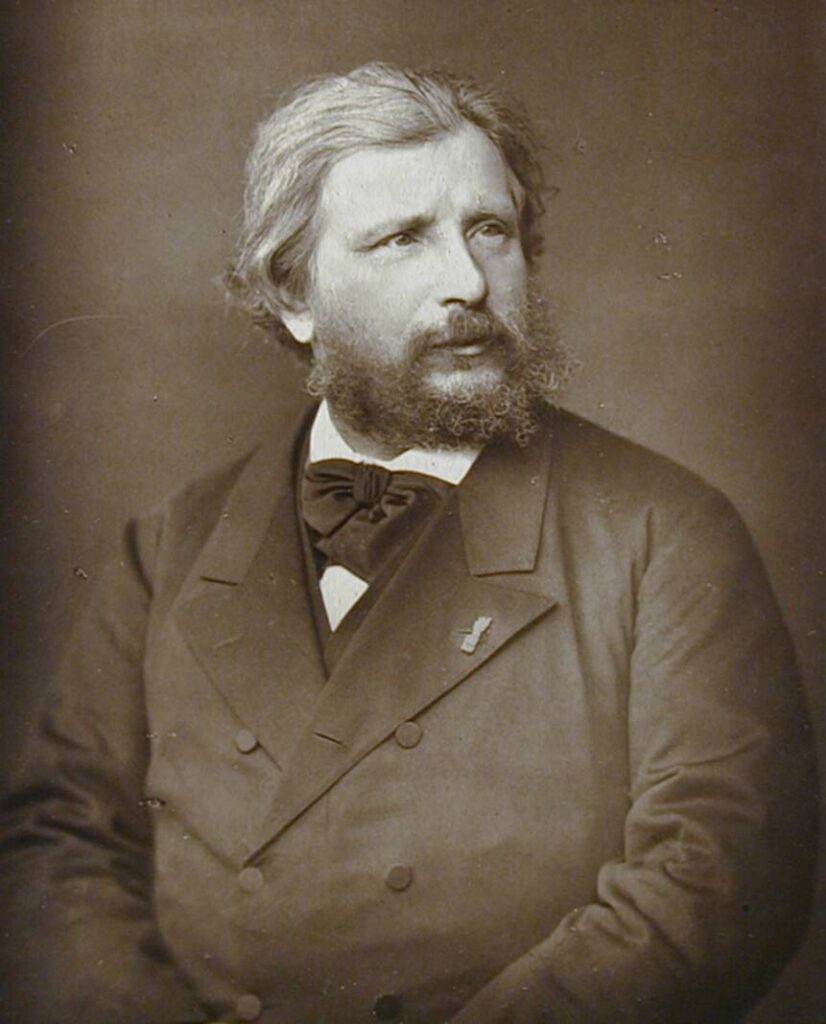
Painting and art more broadly entered my life in an unforeseeable way, like an irreversible turning point, as though someone had lifted a corner of the veil to reveal a hidden truth to me: the truth of the path that had been waiting for me in the shadows.
That turning point has a name: William-Adolphe Bouguereau. And there is one precise image: *The Penitent* (1876). A young woman, draped in black, her gaze frontal, her hands crossed over her chest. Nothing spectacular, and yet that image struck me with such force that I remember it as if it were yesterday.
At that moment, I did not yet have the words for it. I only felt two things.
The first was this: that it was what I wanted to do with my life. When a painting shakes you to the core, you long to understand it, as though telling yourself: I too want to speak that language.
The second: that painting was not merely an image, like the countless ones we see all day long, but that to paint was to create life itself, something from which a soul might emerge, capable of speaking to the deepest part of the viewer.
Later, I learned that this figure represents an image of penitence (some see in it an echo of Mary Magdalene, a theme very present in the nineteenth century). The symbolism is discreet: the contrast between the dark garment and the jewels, signs of a more worldly past, that ambiguity between dignity and fragility. But honestly, it was not the explanation that converted me. It was the power and the energy emanating from this painting.
Bouguereau, the craftsman.
Bouguereau also represents a path that says something about the very nature of the profession. Trained in the great academic tradition, a student at the École des Beaux-Arts, shaped by Rome, exhibited at the Paris Exposition Universelle (1878): in his time, he embodied an exacting vision of painting.
And that is what spoke to me: the idea that one does not merely “express oneself”, one crafts an image. One builds it, refines it, reworks it. One accepts not being brilliant at once. One accepts the invisible hours. The artist is, above all, a craftsman.
At the time I discovered *The Penitent*, I believe that was precisely what I was searching for: proof that beauty could be a discipline, not a matter of chance. Proof that emotion did not stand in opposition to technique, but rather depended upon it. Looking back, I believe Bouguereau offered me something both very simple and very rare: the permission to love beauty without apology. In a world where gentleness is sometimes mistaken for weakness, he reminded me that delicacy can be a form of strength.