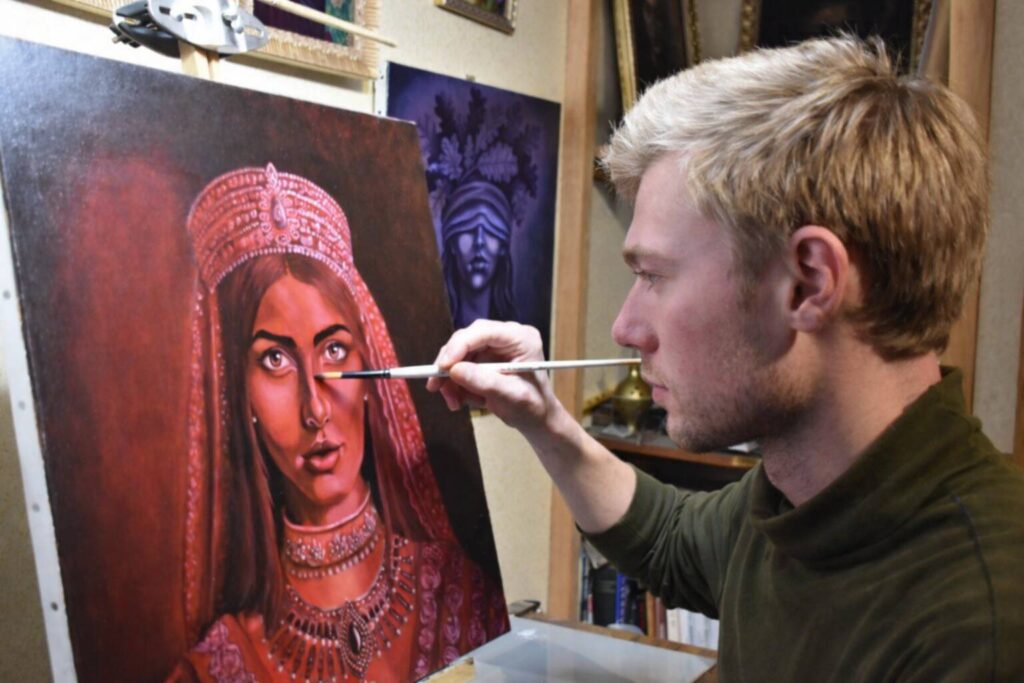
If you look at *The Red Virgin*, take a moment before searching for a story. Here, I did not wish to paint a scene, but a presence. A confrontation. It is a tribute to a timeless feminine dignity: strong, still, and burning. A figure that does not justify itself, does not apologize, but simply stands there—and that alone is enough.
Inspiration: the Byzantine Empire as a visual language
My main source of inspiration comes from the Byzantine Empire, and more specifically from its empresses. I often return to these figures—not to recreate an era, but for what they radiate: a quiet authority, a structured beauty, an almost ceremonial presence.
What guided me were their garments, their jewels, their ornaments. Everything there is language: the material itself, the richness of the motifs, the way a stone or a pearl seems to carry meaning. Splendor is not there merely to “look beautiful”: it asserts a dignity, draws a boundary, and establishes a distance.
In *The Red Virgin*, I draw upon this aesthetic as one would draw upon a grammar, yet I filter it through my own gaze. It is a modern interpretation of the Byzantine Empire: preserving its intensity, its frontality, its icon-like nature, and allowing the details—the crown, the ornaments, the embroidery—to frame the face like a ritual, until the portrait is transformed into a presence.
Why figurative monochrome
I chose monochrome because, if you pay close attention, in art it most often appears on the side of abstraction. In figurative painting, it is encountered far more rarely. And that is precisely what interested me: bringing this very contemporary idea into a more classical figurative painting.
Monochrome allows me to modernize the image without breaking it. It is not a matter of taking away, but of concentrating: limiting the palette so that everything rests on presence, values, materiality, draftsmanship, and the rhythm of detail.
And then there is a more intimate reason: to associate a color with a precise emotion. When a single color prevails, it becomes a language in its own right. It does not merely “color” the painting; it gives it an atmosphere. It fixes a sensation, as though the image were traversed by a single breath.
The first chapter of a series
*The Red Virgin* is the first painting in a series of figurative monochromes. The idea is simple: each work is built around a single dominant color, like an independent chapter, yet one that remains connected to the others.
After red, the series will continue with violet, blue, yellow, and then an orange-brown. Each color will carry its own atmosphere, its own tension, its own way of illuminating the face and its ornaments.
This guiding thread, however, remains unchanged: they will always be female figures. Because that is where I want to delve deeper—into that timeless presence, into that dignity which stands firm, motionless, and yet can enter an entirely different world simply by changing color.
The Creative Process
For this series, I made an important choice: to paint on canvas, whereas I usually work on wood. I wanted a support that felt more direct, more supple, almost more immediate—as though this series needed to breathe differently.
I always begin with drawing: it is the framework, the accuracy of the face, the balance of the ornaments. Then I move directly into color. In a monochrome, I did not feel the need for a *grisaille*: everything is built, from the very beginning, within the same family of tones.
Then come the glazes, layer upon layer, to deepen the light, enrich the values, and bring forth the transitions. And finally, the details: the jewels, the motifs, the sharper accents—everything that gives the painting its presence and rhythm, without ever breaking the unity of the color.
The Emotion of Red
When one finds oneself before *The Red Virgin*, I want it to feel like a confrontation. Not an image to glance over, but a presence that holds you for one moment longer.
I want power to be felt, not violence: a calm, self-possessed power, a bearing that does not seek to persuade. Something imperial, in the simplest sense: a presence that fills the space without moving.
And I want the color to do the rest. I want the red to bring warmth, passion, that impression of contained fire. As though the painting held within itself a silent power: that of standing there, upright, and yielding nothing.